Paint guides
Touch-up vs aerosol vs full respray: what do you need?
Stone chip, scraped bumper or a whole faded bonnet? How to pick between a touch-up bottle, an aerosol and a tin of paint, based on how big the damage is and how deep it goes.

FT Paints
· 6 min read
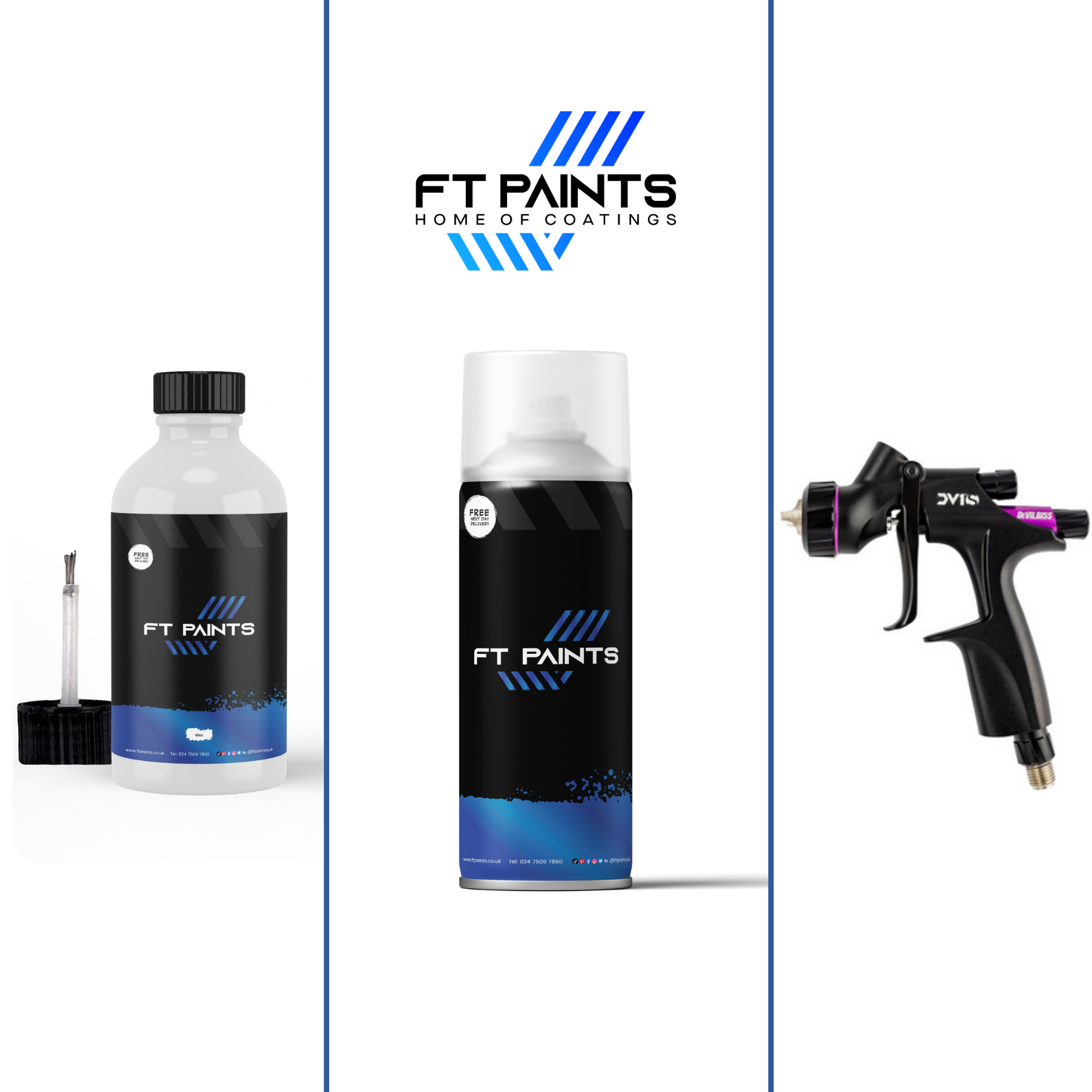
All three options are the same paint, mixed to the same code. What changes is how it goes on and how much area it covers. Pick the wrong one and you either run out halfway across a panel or end up with a blotchy, dabbed-on repair that stands out more than the damage did. Two questions decide it: how big is the damaged area, and how deep does it go.
Step 1: How deep is the damage?
Run a fingernail across the mark. The depth tells you how much prep you need before any colour goes on, whichever size you buy.
- Your nail doesn't catch. The damage is only in the clear lacquer. You may not need paint at all. Try a cutting compound such as 3M Perfect-It III Extra Fine Plus first.
- Your nail catches, and you can see colour underneath. The scratch is into the basecoat. It needs paint, but no primer.
- You can see grey, white or black underneath. That's primer or bare plastic. Paint will go straight on, but bare plastic needs a plastic primer first.
- You can see shiny metal, or rust. You're down to bare metal. Clean back any rust, prime the metal, then paint. Skip the primer and the repair will bubble and flake.
Step 2: How big is the area?
This is what decides between a bottle, a can and a tin. Measure the damage, then add the area around it that you'll need to blend into so the repair doesn't show as a patch.
- Smaller than a 1p coin, or a few chips: touch-up bottle (50ml).
- A long, thin scratch or a cluster of chips: touch-up bottle for fine lines, or step up to a 100ml, 150ml or 250ml bottle if there's a lot of it.
- A patch from palm-sized up to about A4: aerosol (400ml).
- One or two whole panels, like a door and a wing: 500ml tin.
- Two or three panels, like a bonnet and both wings: 1L tin.
- Half the car or more: 2L to 2.5L. Most full resprays of a normal-sized car take 2.5L; larger vans and 4x4s may need 5L.
Touch-up bottle: chips and small scratches
The 50ml touch-up bottle has a brush in the cap. It's made for stone chips on the bonnet and front bumper, door edge dings and short, thin scratches. You're filling the damage, not painting the panel, so it's quick and needs almost no masking.
- Best for: chips and scratches narrower than a pencil line, and anything smaller than a coin.
- Not for: scuffs wider than a few millimetres. Brushing a wide area leaves visible ridges and a patchy finish.
- Tip: build the chip up in several thin layers, letting each one dry, rather than one blob. Use a cocktail stick instead of the brush for very small chips.
If you have a lot of chips, say a whole bonnet's worth, the bigger 100ml, 150ml and 250ml bottles give you more paint for the same job.
Aerosol: scuffs and small patches
The 400ml mixed aerosol is your colour code filled into a spray can. Spraying gives an even, flat coat that you can fade out into the surrounding paint, which a brush can't do. It's the right choice once the damage is too wide to brush but not big enough to justify a spray gun.
- Best for: scuffed bumper corners, kerbed mirror caps, scraped sills and patches up to around A4.
- How much: one can covers a bumper corner or small patch with a couple of coats. For a whole bumper, order two.
- Not for: whole panels. An aerosol struggles to lay paint on evenly across a door or bonnet, and you'll get a blotchy finish, especially on metallics.
- Tip: mask a bigger area than you think, and warm the can in a bowl of warm (not hot) water first for a finer spray.
Tin of paint: panels and full resprays
For a whole panel or more you need paint in a tin, thinned and sprayed with a gun. A gun lays paint on far more evenly than an aerosol over large flat areas, and it's much cheaper per panel. Use the area guide in step 2 to pick a size:
- 500ml: one to two panels.
- 1L: two to three panels.
- 2L: around half a respray.
- 2.5L: most full resprays.
- 5L: full resprays on larger vehicles.
If you don't have a gun or somewhere to spray, our paint service can help, or pop into a branch and ask the counter team.
Do I need lacquer as well?
Probably. Most modern colours, including every metallic and pearl, are two-stage: a basecoat dries matt and needs clear lacquer over the top for gloss and protection. Solid colours are sometimes single-stage, which dry to a gloss on their own. Each colour's page tells you which it is.
- Touch-up repairs: a thin layer of lacquer brushed over the dried basecoat.
- Aerosol repairs: the clear lacquer aerosol.
- Tin or gun repairs: Caslek HS clear lacquer.
What else you'll need
The paint is only part of the job. For anything bigger than a chip, you'll get a better finish with:
- P600 wet-or-dry paper to flatten the damage and key the surrounding paint.
- A Scotch-Brite hand pad to key the blending area where the new paint fades in.
- Masking tape and masking paper to keep overspray off everything else.
- Cutting compound to polish the edge of the repair once the lacquer has cured.
Ready to order?
Every size is mixed to your car's colour code. Search your code or make on the Vehicle Colour Codes page, open your colour, and pick the size you need. Each colour's page lists what it's available in, from the touch-up bottle to the 5L tin, with the aerosol alongside.
Or go straight to your make: Audi, BMW, Mercedes-Benz, Volkswagen, Vauxhall, Nissan, Honda, Kia, SEAT, Skoda or Cupra.
Frequently asked questions
- Can I use a touch-up bottle on a scratch longer than a few centimetres?
- Yes, if it's thin. Touch-up bottles work well on long, narrow scratches. Once the scratch is wider than a few millimetres, brushing leaves ridges and an aerosol will give a better finish.
- How many aerosols do I need for a bumper?
- One 400ml can is enough for a corner or small scuff. For a whole bumper, order two cans of colour, plus a can of clear lacquer if your colour is two-stage.
- Can I respray a whole panel with aerosols?
- You can, but it's hard to get an even finish across a large flat panel, especially with metallic and pearl colours, and you'll use several cans. A 500ml tin sprayed with a gun is cheaper and more even for a whole panel.
- Is the aerosol the same colour as the tin?
- Yes. The aerosol, touch-up bottle and tins are all mixed from the same colour code, so an aerosol repair on a bumper will match a panel sprayed from a tin.
- How much paint do I need for a full respray?
- Most normal-sized cars take around 2.5L of basecoat for a full respray. Larger vans and 4x4s, or a colour change where you're painting door shuts and the engine bay too, may need 5L.